
Why Moisture Testing Matters Before Epoxy Floor Installation
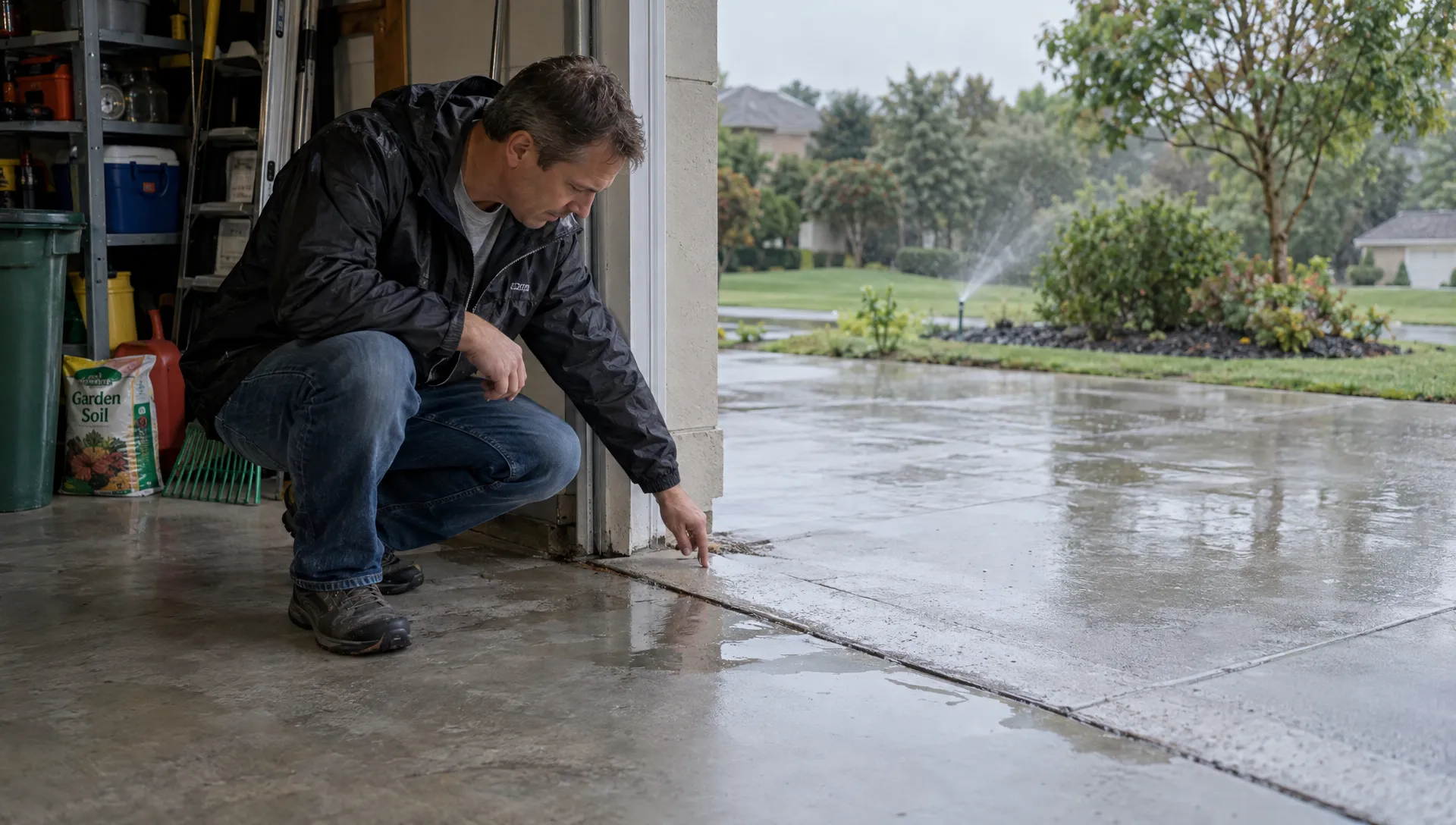
A garage floor can look dry and still contain enough moisture to interfere with epoxy floor installation. Water inside the concrete, moisture moving up from the ground or condensation at the surface can prevent a coating system from performing as intended. Testing helps identify those conditions before the floor is covered, when there are still practical options for addressing them.
For San Diego County homeowners, a sunny forecast is not proof that a garage slab is ready. Coastal humidity, irrigation near the foundation and the slab’s construction can all affect moisture conditions. The useful question is not simply whether the concrete feels dry. It is whether its measured conditions meet the requirements of the coating system being installed.
That distinction matters because grinding, decorative flakes and a durable topcoat cannot compensate for an unresolved moisture problem underneath them. A reliable installation plan starts with understanding the slab, not just choosing the finish.
Why moisture testing matters before epoxy floor installation
Concrete contains pores that allow moisture to move through it. Once a coating covers the surface, the slab’s drying conditions change. If moisture conditions exceed what the coating system can tolerate, the bond between the concrete and coating may deteriorate.
Possible symptoms include blistering, peeling, discoloration or areas that separate from the concrete. Moisture can also contribute to highly alkaline conditions at the bond line, which some coating materials cannot withstand.
Moisture testing reduces uncertainty, but it does not replace proper surface preparation. Oil contamination, weak concrete and an unsuitable surface profile can also cause adhesion problems. A floor needs both acceptable moisture conditions and a properly prepared substrate.
The National Ready Mixed Concrete Association’s guidance on concrete slab moisture explains why moisture evaluation matters before installing moisture-sensitive floor coverings and coatings. The central lesson for homeowners is straightforward: appearance alone is not a dependable acceptance test.
Where moisture in a garage slab comes from
Before epoxy floor installation, it helps to distinguish leftover construction moisture from an ongoing water source. Those situations may require very different responses.
Newer concrete contains water from its original mixture and needs time to dry. Concrete gaining strength and concrete becoming dry enough to coat are separate processes. Reaching a particular age, including the familiar 28-day milestone, does not automatically establish coating readiness.
Existing garage slabs can have moisture problems too. Ground moisture may enter through a missing, damaged or ineffective under-slab vapor retarder. Water can also come from plumbing leaks, irrigation, poor drainage or rain entering around the garage opening.
Condensation is another possibility. When the slab surface is cold enough relative to the surrounding air’s dew point, moisture can collect on top of the concrete. That is different from moisture moving through the slab, although both can affect installation.
White mineral deposits, recurring dark areas or dampness after rain are useful clues. Their absence, however, does not prove that the concrete meets a coating manufacturer’s requirements.
Which concrete moisture tests are useful?
Different tests measure different conditions. The right method depends on the proposed coating system, the slab and the manufacturer’s written requirements. Before epoxy floor installation, ask which test will be used and what its result actually establishes.
In-situ relative humidity testing
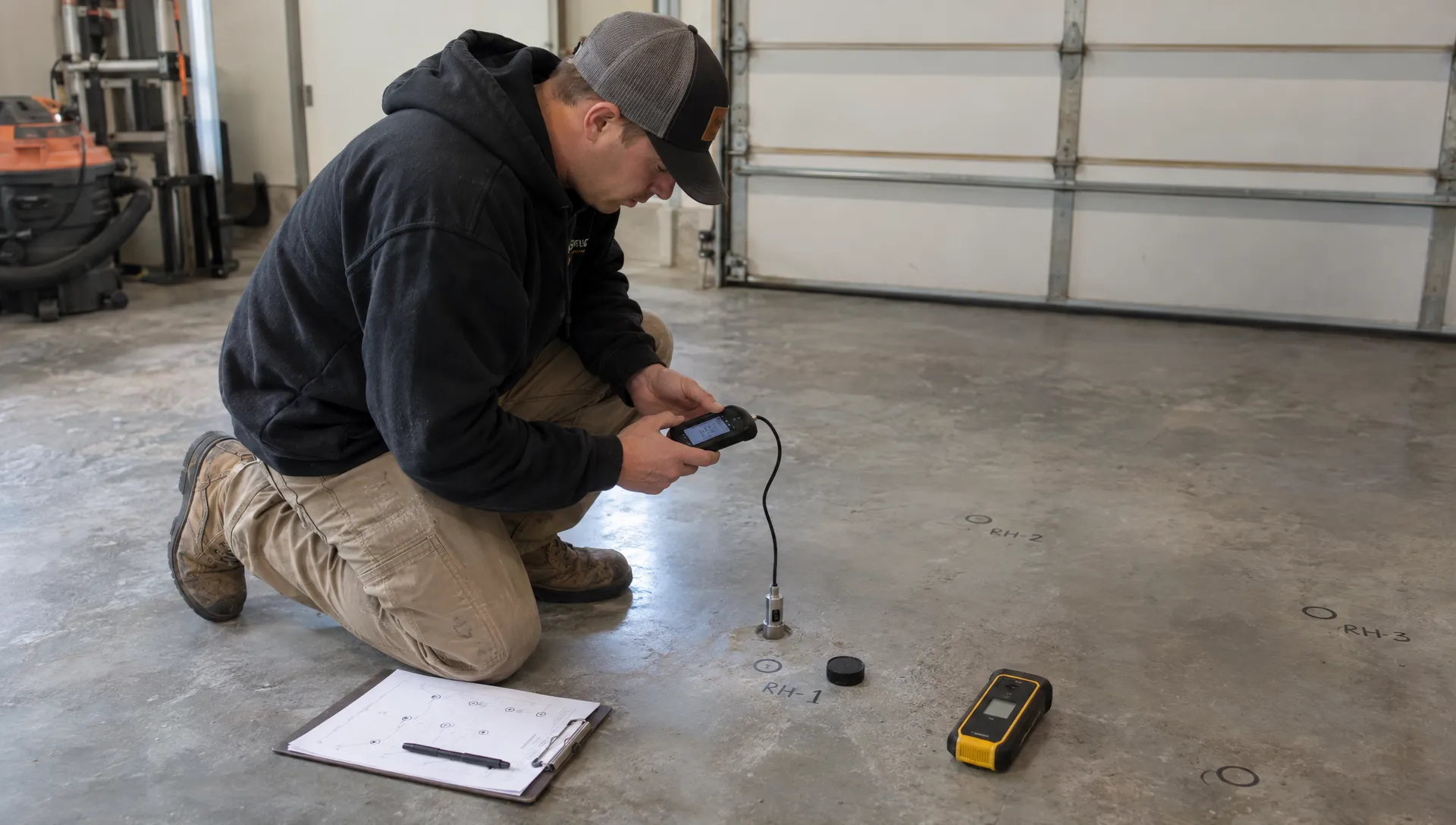
ASTM F2170 measures relative humidity inside a concrete slab using probes placed in drilled holes. It provides information about internal moisture conditions that a surface inspection cannot reveal.
Correct hole depth, test locations, equilibration time and environmental conditions matter. A probe reading taken immediately after drilling is not a substitute for a test performed according to the standard.
For homeowners, the key benefit is visibility into the slab rather than just its exposed surface. The resulting RH percentage must then be compared with the selected coating system’s limits.
Calcium chloride testing
ASTM F1869 measures the moisture vapor emission rate from a prepared concrete surface over a specified test period. Results are typically reported in pounds of moisture per 1,000 square feet over 24 hours.
This measurement is not interchangeable with an internal RH reading. A coating manufacturer may specify one method, accept either method under stated conditions or require additional evaluation.
| Evaluation method | What it tells you | Important limitation |
|---|---|---|
| In-situ RH testing, ASTM F2170 | Relative humidity within the slab | Requires correct placement and equilibration |
| Calcium chloride testing, ASTM F1869 | Moisture emission from the tested surface during the test period | Results depend on prescribed preparation and conditions |
| Handheld concrete moisture meter | Relative differences that can help locate suspect areas | A generic meter reading does not replace a specified acceptance test |
| Plastic sheet evaluation, ASTM D4263 | Whether moisture becomes visibly apparent beneath a sealed sheet | A negative result does not establish compliance with RH or emission limits |
Surface checks and screening tools
Handheld meters can help an installer identify areas that deserve closer investigation. Plastic sheet checks may reveal condensation or darkening. Both can provide useful clues, but neither should be treated as universal proof that a slab is ready.
The distinction is between screening for a possible problem and documenting compliance with a coating specification. Ask which role each check serves.
How to interpret the results
There is no single moisture number that makes every garage coating safe to install. For epoxy floor installation, acceptance limits must come from the manufacturer of the specified system, including its primer and any moisture-control layer.
A percentage shown by a handheld meter is not automatically equivalent to an ASTM F2170 RH percentage. Likewise, a calcium chloride emission result cannot simply be converted into an internal RH reading.
A useful test report should identify the method, test locations, results and relevant environmental conditions. Those findings should be compared with the manufacturer’s current written requirements, not a general rule remembered from another project.
Testing also describes conditions during the evaluation. It cannot guarantee that a future plumbing leak or drainage problem will never introduce water.
If readings differ across the garage, ask what explains the variation. A single favorable spot should not be used to dismiss a wetter area near a wall, crack or garage opening.
What happens if the concrete is too wet?
An unfavorable result does not necessarily mean the garage can never be coated. It means the installation plan needs to address the cause and the coating system’s limits.
Allow more drying time when appropriate
For a newer slab with no continuing water source, additional drying time may help. Ventilation and environmental control can support drying where practical, but the floor still needs retesting rather than approval based only on elapsed time.
Delaying epoxy floor installation is usually less disruptive than removing a failed coating and preparing the concrete again. An installation date should follow acceptable conditions, not override them.
Investigate ongoing water entry
Recurring seepage, a suspected plumbing leak or drainage toward the garage needs investigation. A coating is not a substitute for correcting those conditions.
Active water intrusion or suspected hydrostatic pressure may require assessment beyond routine floor preparation. Applying a general-purpose primer over the affected area is not a dependable solution.
Use a compatible mitigation system when specified
Some manufacturers offer moisture-mitigation products designed for defined slab conditions. These are not interchangeable with ordinary epoxy primers, and their limits, preparation requirements and compatibility must be checked.
The proposed assembly should be evaluated as a complete system: concrete preparation, mitigation layer if needed, base coat and topcoat. Ask whether additional treatment changes the project scope, cost or schedule.
Fast-curing coatings still need moisture evaluation
Switching coating chemistry does not eliminate the need to evaluate the concrete. Epoxy, polyurea and polyaspartic products have different properties, but each system has substrate and environmental requirements.
If you are comparing polyaspartic garage floor coatings for a San Diego home, keep cure speed separate from moisture tolerance. A product that cures quickly is not automatically approved for a wet slab.
The same distinction applies to scheduling. A one-day coating installation describes the application work under suitable conditions. It does not mean every moisture test can be started, completed and interpreted that same morning.
For epoxy floor installation or a fast-curing alternative, any required testing should be planned early enough to allow proper test procedures and follow-up decisions. This helps prevent a loaded garage, a booked installation crew and an unresolved moisture result from colliding on installation day.
What homeowners should ask before approving the work
You do not need to become a concrete technician to evaluate a proposal. You do need a clear explanation of how the installer determines whether your slab is suitable.
These questions focus the conversation on evidence rather than reassurance:
- Which moisture test does the proposed coating manufacturer require? Ask how the chosen method matches the system’s written instructions.
- Will I receive the findings? Request the test locations, results and applicable acceptance limits.
- What happens if part of the slab fails? Clarify whether the next step is further investigation, drying, mitigation or a change in system.
- Are surface temperature and dew point checked? Internal moisture testing does not replace installation-day environmental checks.
- How would extra work affect the quote and warranty? Get the scope and any relevant moisture exclusions in writing.
Good answers should connect the actual slab conditions to the proposed materials. “We coat garages like this all the time” is not the same as explaining why this floor meets the requirements.
Keep the report and product information with your project records. They document the conditions used to approve the work and can be useful if questions arise later.
Frequently asked questions
Does an older garage need moisture testing before epoxy floor installation? Yes. Age alone does not establish that a slab is dry enough. Ground moisture, leaks or changes in drainage can affect concrete long after construction.
Is waiting 28 days after a concrete pour enough? Not necessarily. Concrete curing and drying are different processes. Readiness depends on measured conditions and the coating manufacturer’s requirements, not just the pour date.
Can grinding remove a moisture problem? Grinding prepares the surface by removing unsuitable material and creating a profile for adhesion. It does not stop moisture entering from below or correct a leak.
Can a moisture-blocking primer solve every problem? No. A moisture-mitigation product must be suitable for the measured conditions and compatible with the complete coating system. Active water intrusion needs separate attention.
Does a dry-looking floor after several sunny days mean it is ready? No. The surface may dry while moisture remains deeper in the slab. Appropriate testing provides information that a visual check cannot.
Plan the coating around the slab’s condition
Bay City Coatings installs epoxy, polyurea and polyaspartic garage floor coatings throughout San Diego County. Its service includes surface preparation, decorative flakes and a durable topcoat, with most installations completed in one day.
When requesting a garage floor coating quote from Bay City Coatings, ask how moisture evaluation applies to your slab and proposed system. You can also call 619-363-1055 to discuss the project.
Before approving epoxy floor installation, make sure the proposal explains how the concrete will be evaluated, what conditions the coating requires and what happens if the slab does not meet them.
Ready for Your Free Quote?